
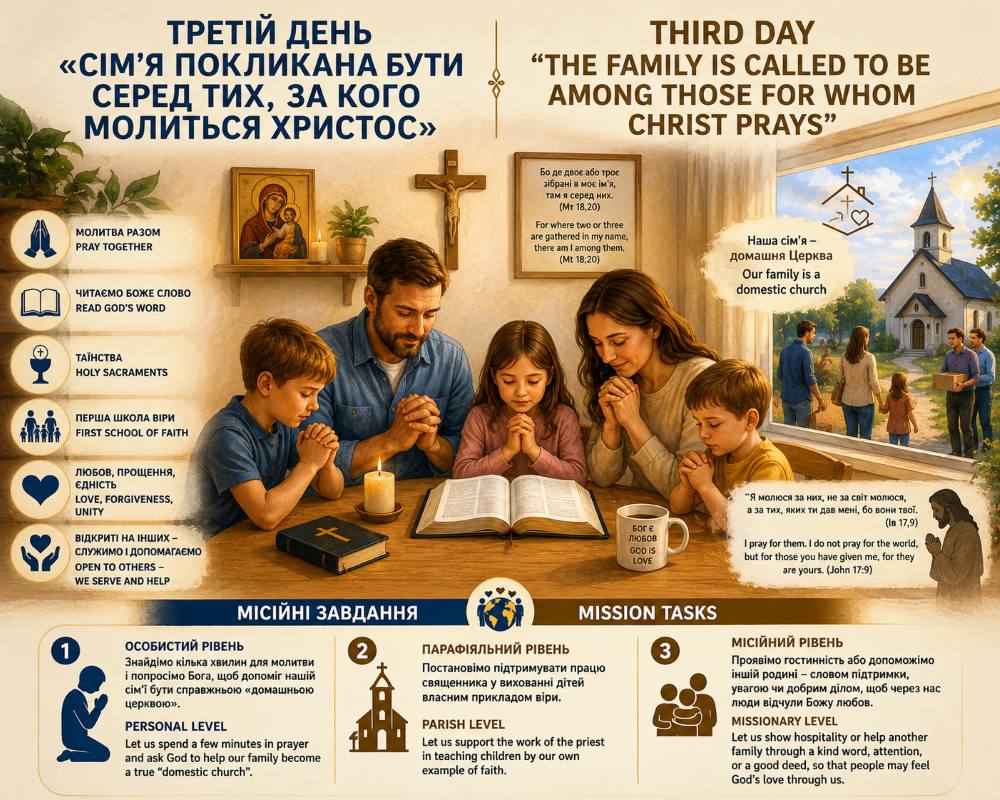
“THE FAMILY IS CALLED TO BE AMONG THOSE FOR WHOM CHRIST PRAYS”
Sunday (May 17/24)
John 17:1–13
The Gospel passage appointed by the Church for today is the beginning of the so-called High Priestly Prayer of Jesus in the Gospel of John. In many ways, it is the theological summary of Christ’s whole life and mission before His suffering and death. A special part of this prayer is dedicated to His disciples:
“I pray for them. I do not pray for the world, but for those whom You have given Me, for they are Yours” (John 17:9).
In these words we see Jesus’ special intercession for those who believe in Him. When He says, “I do not pray for the world,” it does not mean that God does not love the world. In the Gospel of John, the word “world” often means a reality that is closed to God and rejects Him. Jesus prays especially for those who have opened their hearts to God’s word, accepted Him, and become part of the community of believers, so that they may remain in truth and unity with the Father.
How important it is today for every Christian family not to become “part of the world” that closes itself to God, but to be among those for whom Christ prays. According to God’s plan, the family is called to be a “domestic church,” a place where God’s presence lives. The strength of the family is not only in human feelings, but in living by God’s word and belonging to the community of believers.
What does it mean in practice to be a “domestic church”? First of all, it means that a Christian family is called to make its daily life a place of meeting with God: through common prayer, reading God’s word, and participation in the Holy Mysteries. At the same time, the family is naturally called to become the first school of faith, because it is in the family that children first come to know God through the living witness of their parents.
Sometimes it is very difficult for priests to teach children and young people the foundations of the Christian faith when this work is not supported at home. Without this cooperation, the words of the priest often remain only theory and are not confirmed by real life. On the other hand, when a family truly lives its faith, even a simple word from a priest can bear fruit in the life of a child.
To be a domestic church also means becoming a place of true love — maybe not perfect love, but living love. Family love should be built according to the example of Christ’s love: sacrificial, faithful, patient, ready to forgive, and willing to serve. In this way, true and deep unity grows within marriage and family life. This unity is a gift from God and reflects the deep unity for which Christ prays in the Gospel of John (see John 17).
Finally, the domestic church does not close itself off from others but remains open to them. Such a family knows how to welcome, share, help, and witness to faith in the world through hospitality, support for those in need, and sincere Christian living.
Therefore, let us open our families to God’s word and make them true “domestic churches,” so that by living in prayer, love, and unity, we may be among those for whom Christ prays in the Gospel of John, and through whom His presence becomes visible in the world.
Missionary Tasks:
Personal Level:
Today, let us spend a few minutes in personal prayer and ask God to help our family become a true “domestic church.”
Parish Level:
If we are not already doing so, let us support the work of the priest in teaching children by giving them our own example of faith.
Missionary Level:
Let us show hospitality or help another family today through a kind word, attention, or a good deed, so that through us people may feel God’s love.