10/08/2026 – Життя Святих / Lives of the Saints
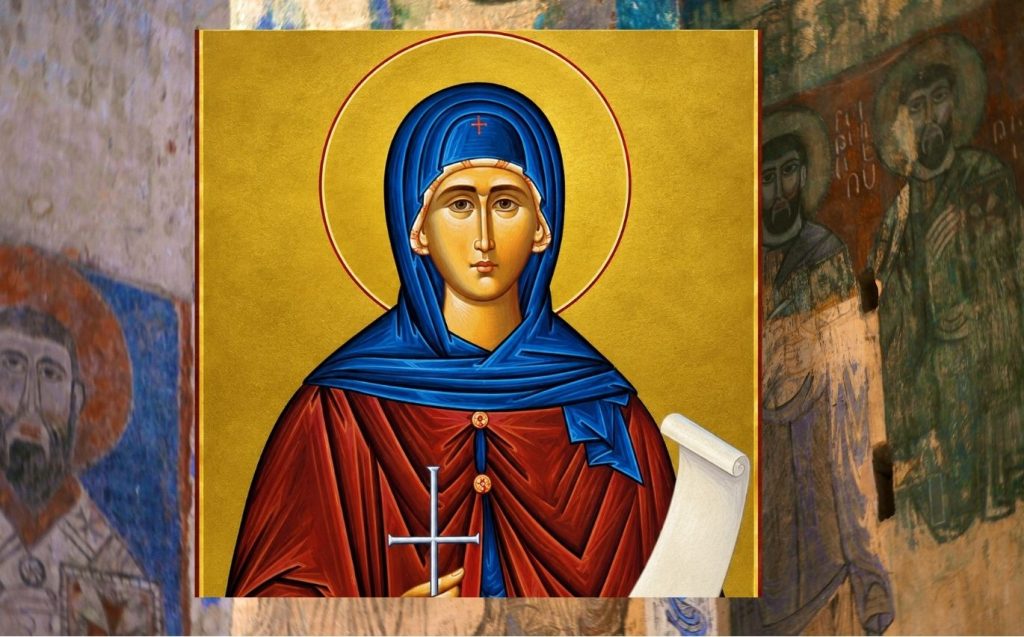
Прп. Пелагії
Venerable Pelagia the Penitent
The Synaxarion (Lives of the Saints):
The Holy Saint Pelagia the Penitent lived in Antioch of Palestine and became one of the great examples of repentance in the early Church.
Before she became a Christian, Pelagia lived a very different life. She was the leader of a group of dancers and was known for her great beauty, wealth, and worldly lifestyle. She lived in sin and prostitution and cared greatly about her appearance and the attention she received from others.
But God did not abandon her.
One day, Pelagia was passing by a church dressed in beautiful and expensive clothing. Inside the church, Saint Nonnus, Bishop of Edessa, was preaching. The people who saw Pelagia turned their faces away from her because they knew about her sinful life.
Saint Nonnus, however, did not look at her with hatred or contempt. He looked at her differently. He saw not only the sinful life she was living, but also the soul that God had created and the spiritual greatness that could still grow within her.
After Pelagia had passed by, Bishop Nonnus went to his cell and prayed for a long time for her salvation.
Later, he spoke to the other bishops about what they had seen. He told them that Pelagia, although living in sin, put them to shame in one important way. She spent great effort making her body beautiful and attractive in the eyes of other people, while they often failed to give the same attention to their souls.
He said, in effect: “She takes great care to adorn her body, while we take so little care to adorn our souls.”
These words reveal an important spiritual truth. We often spend much time caring for our appearance, our homes, our work, our possessions, and the way other people see us. But how much time do we spend caring for the condition of our soul?
The next day, Saint Nonnus was preaching in the church about the Last Judgment. He spoke about the coming judgment of God and the eternal consequences of the choices we make in this life.
Pelagia happened to enter the church and heard the sermon.
The words of the bishop touched her heart deeply. She suddenly understood the emptiness of the life she had been living. She saw that beauty, wealth, pleasure, and the admiration of people could not give her true happiness or eternal life.
She began to weep and, filled with the fear of God and sincere repentance, approached Bishop Nonnus.
She asked him to baptize her and to receive her into the Christian faith.
The bishop recognized that her repentance was sincere. He did not reject her because of her past. Instead, he welcomed her and baptized her in the name of the Father, and of the Son, and of the Holy Spirit.
Through Baptism, Pelagia received a new beginning.
But her conversion was not the end of the struggle.
That night, the devil appeared to her and tried to convince her to return to her former life. The temptation was strong, but Pelagia turned to God. She prayed and made the Sign of the Cross.
Immediately, the devil disappeared.
This reminds us that conversion does not mean that temptation suddenly disappears. When we turn toward God, we may still be tempted to return to our old ways. But we do not fight alone. We have prayer, the grace of God, the Sacraments, and the power of the Cross.
Three days after her Baptism, Pelagia gathered together all the valuables and possessions she had gained during her former life. She brought them to Bishop Nonnus.
The bishop ordered that her wealth be given to the poor. He said: “Let this be wisely dispersed, so that these riches gained by sin may become a wealth of righteousness.”
What had once been connected with her sinful life could now become a blessing for others.
Pelagia then made an even greater decision. She left her former life completely and traveled to Jerusalem. She went to the Mount of Olives, where she lived in a small cell in prayer, fasting, and solitude.
For the sake of humility and complete separation from her former identity, she lived disguised as a monk named Pelagius. She devoted herself entirely to God and became known for her deep spiritual life and holiness.
People who encountered her saw only a humble monk. They did not know the remarkable story of the woman who had once lived a life of sin but had completely given herself to Christ.
Saint Pelagia remained there in ascetic prayer until the end of her earthly life. When she died, she was buried in the cell where she had spent her final years.
The story of Saint Pelagia is a powerful reminder that no one is beyond the mercy of God.
Her past did not determine her future. The life she had lived did not prevent God from calling her to holiness. When Pelagia opened her heart to Christ, repentance became the beginning of a completely new life.
Her story also teaches us not to judge people only by what we see on the outside. The people in the church saw a sinful woman and turned away. Saint Nonnus saw a soul that could still be transformed by God’s grace.
We should remember this when we look at ourselves and when we look at others.
God does not ask us to pretend that sin is not serious. He asks us to believe that His mercy is greater than our sin when we sincerely turn back to Him.
Saint Pelagia teaches us that repentance is not simply feeling sorry for the past. True repentance means turning around and walking in a new direction.
May Saint Pelagia the Penitent pray for us, that we may never lose hope in God’s mercy, that we may care more for the beauty of our souls than for our outward appearance, and that we may have the courage to leave behind whatever separates us from Christ.
May her example remind us that with God, a new beginning is always possible.