10/15/2026 – Життя Святих / Lives of the Saints
Прп. Євтимія Нового
Св. прпмч. Лук’яна, пресвіт. Великої Антіохії
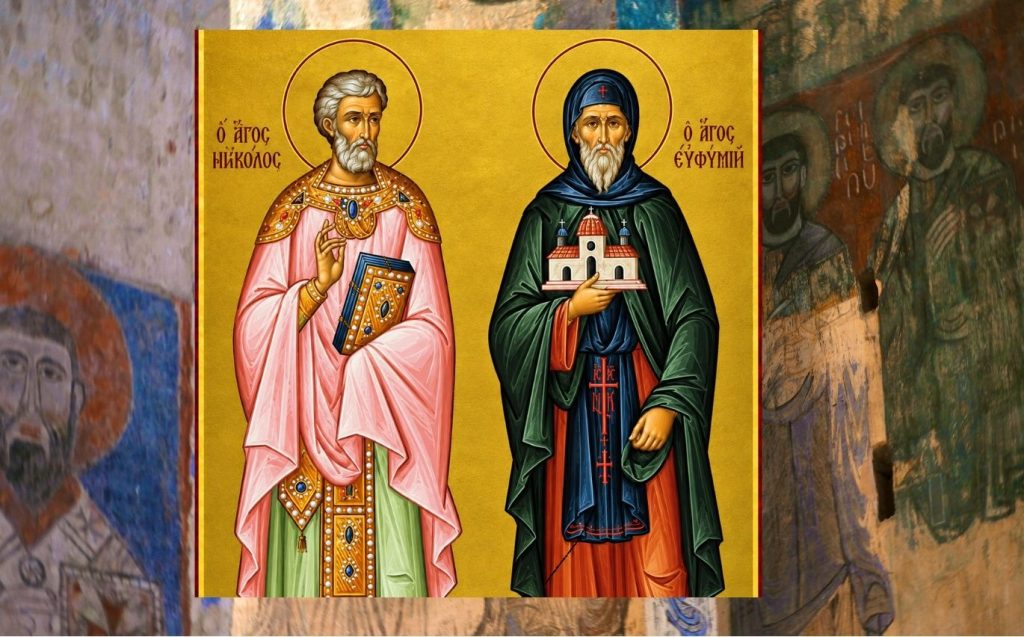
Venerable Euthymius the New of Thessalonica, and Monk of Mount Athos
Martyr Lucian the Presbyter of Antioch
The Synaxarion (Lives of the Saints):
Saint Euthymius the New of Thessalonica and Mount Athos was born in the city of Ancyra in Galatia. His name in the world was Nicetas. His parents, Epiphanius and Anna, were devout Christians who lived virtuous lives. From childhood, Nicetas was known for being gentle, obedient, and devoted to God.
When he was only seven years old, his father died. Nicetas soon became the main support for his mother. When he grew older, he entered military service. At his mother’s request, he married, and later they had a daughter.
Although he now had a family and responsibilities, Nicetas felt a deep calling to give his entire life to God. After some time, he secretly left his home and entered monastic life.
For fifteen years, he lived as an ascetic on Mount Olympus, learning the spiritual life from experienced monks and elders.
Eventually, Euthymius decided to move to Mount Athos. On his journey, he learned that his mother and wife were still alive and in good health. He told them that he had become a monk and sent them a cross, inviting them to follow the path of complete dedication to God.
Later, both his mother and his wife entered monastic life.
On Mount Athos, Euthymius received the Great Schema, the highest form of monastic commitment. He then lived for three years in a cave, in deep silence, prayer, fasting, and spiritual struggle.
His life was not easy. He experienced temptations and many spiritual battles, but he continued to place his trust in God.
For a long time, Saint Euthymius also lived as a stylite near Thessalonica. A stylite was a monk who lived on a pillar or elevated place as an expression of radical ascetic devotion.
People came to him seeking spiritual advice, encouragement, and healing. Through his prayer and closeness to God, many people received help.
As Saint Euthymius continued to purify his heart and mind through prayer, he became known for profound spiritual insight and divine revelations.
In the year 863, at the command of the Lord, Saint Euthymius founded two monasteries on Mount Peristeros, not far from Thessalonica.
He guided these communities for fourteen years. Although he was a deacon, he became a spiritual father to many monks and helped establish a life centered on prayer, repentance, and service to God.
His mother and wife also received monastic tonsure and dedicated the rest of their lives to God.
Near the end of his life, Saint Euthymius withdrew to the island of Hiera on Mount Athos. He died there in the year 898.
His relics were later transferred to Thessalonica.
He is called “the New” to distinguish him from Saint Euthymius the Great, whose feast is celebrated on January 20.
The life of Saint Euthymius reminds us that God’s call can sometimes lead us in a direction we did not expect.
He was a husband, a father, and a soldier. Yet deep within his heart he heard a call to a different kind of life.
His story also reminds us that following Christ does not mean that we stop caring about those we love. His mother and wife eventually followed the same spiritual path and devoted themselves to God.
The Church also commemorates the Hieromartyr Lucian, Presbyter of Antioch.
Saint Lucian was born in the Syrian city of Samosata. He became an orphan when he was only twelve years old.
Instead of keeping his possessions for himself, Lucian gave what he had to the poor. He then traveled to Edessa, where he came under the spiritual guidance of the confessor Macarius.
There he devoted himself to studying Holy Scripture and learning the discipline of the spiritual life.
Because of his faith and his dedication to spreading Christianity among Jews and pagans, Lucian was ordained a priest.
In Antioch, he established a school where many students came to study.
Saint Lucian did not teach them only academic knowledge. He taught them how to understand the Holy Scriptures and, even more importantly, how to live a virtuous Christian life.
He was also deeply involved in preserving the biblical text. He carefully reviewed and corrected the Greek text of the Septuagint, which had been affected by errors introduced by copyists and, according to the tradition, by those who intentionally changed passages to support false teachings.
The corrected text was hidden inside a wall during the time of persecution. According to the tradition of the Church, it was later discovered during the reign of Saint Constantine the Great.
When the persecution under Emperor Diocletian began, Saint Lucian was arrested and sent to prison in Nicomedia.
He remained there for nine years.
Even in prison, Lucian continued his ministry. He encouraged the Christians imprisoned with him to remain faithful to Christ. He reminded them not to fear torture or death, because Christ is stronger than death.
The saint himself endured terrible suffering. He was tortured, deprived of food, and eventually became extremely weak.
Yet he remained faithful.
Before his death, Saint Lucian desired to receive the Holy Mysteries of Christ on the Feast of Theophany.
Some Christians who were able to visit him secretly brought bread and wine.
Saint Lucian was bound in chains and lying on sharp pieces of pottery because of the cruelty of his imprisonment. Yet he offered the Eucharistic Sacrifice upon his own chest, and the Christians who were with him received Holy Communion.
This is one of the most moving details of his life. Even when everything had been taken away from him, no one could take Christ away from him.
The next day, the emperor sent soldiers to see whether Lucian was still alive.
The exhausted priest looked at them and said three times: “I am a Christian.”
Then he gave his soul into the hands of God.
The authorities threw his body into the sea. But after thirty days, his body was brought back to the shore by dolphins. Christians found him and buried him with reverence.
Saint Lucian’s life teaches us the power of faithfulness. He served Christ as a teacher, priest, biblical scholar, spiritual father, and finally as a martyr.
Saint Euthymius and Saint Lucian lived very different lives. One sought God through monastic prayer and asceticism; the other served Christ through teaching, priestly ministry, and suffering in prison.
But both understood that our life belongs to God.
Their example invites us to ask ourselves: What is God asking of me today?
We may not be called to live in a cave or to die as martyrs. But every Christian is called to prayer, faithfulness, generosity, and courage.
May Saint Euthymius the New pray for us, that we may recognize God’s call in our lives and have the courage to follow Him.
May the Hieromartyr Lucian pray for us, that we may remain faithful to Christ in every circumstance and never be ashamed to say with our lives and our words: “I am a Christian.”