
10/20/2026 – Життя Святих / Lives of the Saints
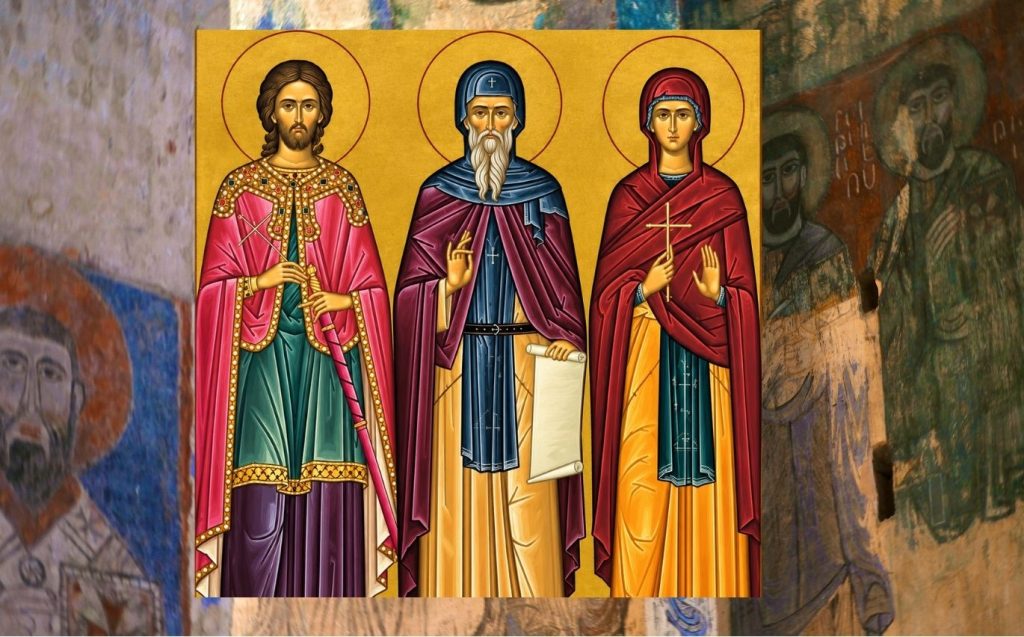
Св. вмч. Артемія
Greatmartyr Artemius at Antioch
The Synaxarion (Lives of the Saints):
The Holy Great Martyr Artemius of Antioch
The Holy Great Martyr Artemius of Antioch was a distinguished military leader who lived during the reigns of the Emperor Constantine the Great and his son, Constantius. He was known for his courage, leadership, and faithful service to the empire. Because of his bravery, he received many honors and was eventually appointed to an important position as ruler of Egypt.
Yet Saint Artemius did not use his authority only for worldly purposes. As a Christian, he understood that every position of responsibility is also an opportunity to serve God and others. During his time in Egypt, he worked to strengthen and spread the Christian faith.
The Emperor Constantius entrusted Artemius with an important mission. He was sent to bring the relics of the Holy Apostle Andrew from Patras and the relics of the Holy Apostle Luke from Thebes in Boeotia to Constantinople. The precious relics were placed with great honor in the Church of the Holy Apostles.
Because of his distinguished service, Artemius was appointed ruler of Egypt. He had both military authority and great responsibility, but his heart remained devoted to Christ.
After the death of Constantius, Julian became emperor. History remembers him as Julian the Apostate because he attempted to restore pagan religion and reverse the Christian faith that had begun to flourish in the Roman Empire.
Julian became hostile toward Christians and ordered many of them to be persecuted and killed. In Antioch, he ordered two bishops to be tortured because they refused to abandon their faith in Christ.
At this difficult time, Saint Artemius arrived in Antioch. Seeing what was happening to the Christians, he could not remain silent. He openly denounced Julian’s actions and condemned his persecution of the Church.
For speaking the truth, Artemius himself became a target of the emperor’s anger. Julian ordered that the saint be tortured and then thrown into prison.
In the darkness of the prison, Saint Artemius turned to prayer. While he was praying, Christ appeared to him surrounded by angels. The Lord encouraged His servant, promising to remain with him and to give him the crown of glory.
Christ reminded Artemius that he had confessed Him before people on earth and promised that He would confess him before the Heavenly Father.
Strengthened by this vision, Saint Artemius gave thanks and glorified God. His sufferings had not separated him from Christ. Instead, they had brought him even closer to the Lord.
The following day, Julian again demanded that Artemius honor the pagan gods. The saint firmly refused.
The emperor ordered even more terrible tortures. Yet Artemius endured everything without denying Christ. His body suffered, but his faith remained unshaken.
Finally, the saint warned Julian that those who persecute God’s people will answer before God. The emperor became even more furious and ordered further tortures.
Nothing could break the faith of the Great Martyr Artemius. At last, he was beheaded and received the crown of martyrdom.
Christians secretly buried his body, preserving the relics of the saint who had remained faithful to Christ until death.
Saint Artemius had also warned Julian that his persecution and rejection of God would bring a terrible end. After Artemius’ martyrdom, this prophecy was fulfilled.
Julian left Antioch to lead a military campaign against the Persians. Near the city of Ctesiphon, he encountered an elderly Persian man who offered to guide his army. The man deceived Julian and led the army into a wilderness where there was little food or water.
Exhausted by hunger and thirst, Julian’s army was forced to fight against fresh Persian forces. During the battle, Julian was suddenly and mortally wounded.
According to the tradition of the Church, he was struck by an unseen hand and an unseen weapon. As he lay dying, Julian cried out: “You have conquered, Galilean!”
The Christian tradition understood these final words as a recognition that Christ, whom Julian had rejected and persecuted, was ultimately victorious.
After the death of Julian, the relics of the Great Martyr Artemius were transferred with honor from Antioch to Constantinople.
Saint Artemius is remembered not only as a courageous soldier, but above all as a faithful servant of Christ. He had power and authority in the world, yet when he was asked to choose between earthly power and faithfulness to God, he chose Christ.
His life reminds us that courage is not simply the absence of fear. True Christian courage is remaining faithful when fear, pressure, suffering, or persecution tells us to give up.
Saint Artemius teaches us that no earthly position is more important than our relationship with God. Wealth, honor, authority, and success can all disappear. But faithfulness to Christ leads to eternal life.
When Saint Artemius was alone in prison, Christ did not abandon him. The Lord strengthened him with the promise: “I am with you.”
These words are also a source of hope for us. We may face suffering, uncertainty, rejection, or difficult moments in our own lives, but Christ remains near to those who place their trust in Him.
May the Holy Great Martyr Artemius pray for us, that we may have courage in times of difficulty, faithfulness in times of testing, and the strength to confess Christ not only with our words, but also through the way we live.
May we never forget the promise of our Lord: those who remain faithful to Him are never alone.