10/14/2026 – Життя Святих / Lives of the Saints
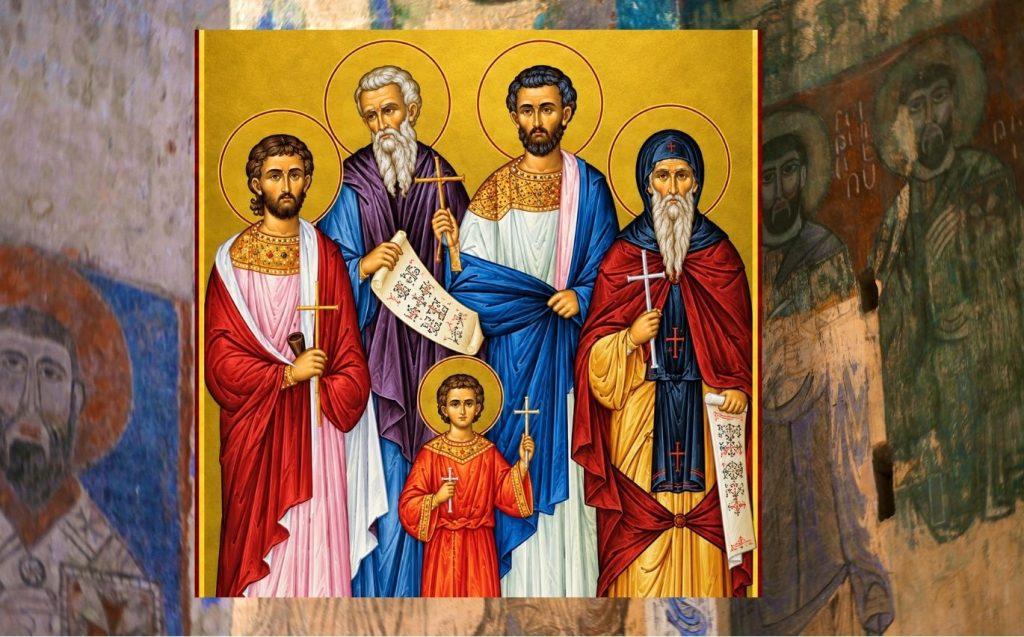
Свв. мчч. Назарія, Гервасія, Протасія й Келсія
Прп. Параскеви Терновської
Блаж. сщмч. Романа Лиска, пресвіт.
Martyrs Gervasius, Nazarius, Protasius, and Celsus of Milan
Venerable Paraskevi (Petka) of Serbia
The Synaxarion (Lives of the Saints):
The Holy Martyrs Nazarius, Gervasius, Protasius, and Celsus suffered for Christ during the reign of the Roman Emperor Nero, in the first century.
Saint Nazarius was born in Rome to a Christian mother named Perpetua and a father named Africanus. He was baptized by Saint Linus, Bishop of Rome. From his youth, Nazarius desired to dedicate his life to Christ. He especially wanted to serve Christians who were suffering because of their faith.
For this reason, he left Rome and traveled to Milan, where he visited and encouraged Christians who were being persecuted.
In Milan, Nazarius met two brothers, Gervasius and Protasius. They were twins and were the sons of wealthy Roman citizens, Vitalius and Valeria.
After their parents died, the brothers received their inheritance. But instead of using their wealth for themselves, they gave their possessions to the poor, freed their slaves, and devoted themselves to fasting, prayer, and the service of God.
Because they were Christians, Gervasius and Protasius were arrested and placed in prison.
When Nazarius visited the Christians in the prison, he met the two brothers. He grew deeply attached to them and desired to share their suffering for Christ.
The authorities discovered that Nazarius was visiting the prisoners. They had him beaten and then expelled him from the city.
Nazarius continued his missionary journey and traveled to Gaul, the region that is now modern France. There he preached the Gospel and brought many pagans to faith in Christ.
During his missionary work, Nazarius met a Christian woman who entrusted her young son Celsus to him. Nazarius baptized the boy, raised him in the Christian faith, and eventually Celsus became his faithful disciple and companion in missionary work.
The two traveled together preaching Christ.
Because of their preaching, Nazarius and Celsus were arrested. The pagans attempted to kill them in several ways.
They were thrown before wild animals, but the animals refused to harm them.
Then the persecutors attempted to drown them in the sea. But the two martyrs remained unharmed and, according to the tradition of the Church, walked upon the water as though it were dry land.
The soldiers who had been ordered to carry out their execution were astonished by what they witnessed. Instead of continuing the persecution, they themselves believed in Christ. They released the martyrs and accepted the Christian faith.
Nazarius and Celsus eventually returned to Milan and visited Gervasius and Protasius in prison.
Because of this, they were brought before the Emperor Nero. The emperor ordered Nazarius and Celsus to be beheaded.
Soon afterward, Gervasius and Protasius were also executed for their faith.
A Christian named Philip secretly recovered the bodies of all four martyrs and buried them in his own house.
Many years later, their relics were discovered through God’s providence.
During the time of Saint Ambrose, Bishop of Milan, the relics of Gervasius and Protasius were discovered after Saint Ambrose received a revelation concerning their location.
Later, during the reign of the Emperors Arcadius and Honorius, Saint Ambrose also discovered the relics of Nazarius and Celsus.
The relics of all four martyrs were honored by the faithful, and many healings were reported through their intercession. They were solemnly transferred to the cathedral of Milan.
The story of these four martyrs reminds us that the Christian faith is not only something we receive; it is something we share.
Nazarius did not keep his faith to himself. He traveled from place to place, encouraged Christians, preached the Gospel, and brought others to Christ.
Gervasius and Protasius gave their wealth to the poor and their lives to God.
Celsus learned the faith from Nazarius and then became his companion in spreading the Gospel.
Each one served God in a different way, but all remained faithful until death.
The Church also commemorates Saint Paraskevi the New, who lived during the eleventh century.
Saint Paraskevi was born into a deeply Christian family in the village of Epivato, near Constantinople. Her older brother Euthymius became a monk and later a bishop.
From a young age, Paraskevi desired to give her life completely to God.
One day, while attending the Divine Liturgy, she heard the words of Christ: “If anyone wishes to come after Me, let him deny himself, take up his cross, and follow Me.”
These words touched her heart deeply.
Paraskevi began to understand that following Christ requires more than simply believing in Him. It requires giving ourselves to God.
She began giving her clothing and possessions to people who were poor. Her family did not understand her decisions, and she experienced much suffering because of them.
After her parents died, Paraskevi entered monastic life at the age of fifteen.
She eventually withdrew to the desert near the Jordan River, where she lived a life of prayer, fasting, and spiritual struggle. She remained there for many years, seeking to draw closer to God.
When she was twenty-five, an angel of the Lord appeared to her and instructed her to return to her homeland.
Paraskevi obeyed and returned to Epivato. She remained there for two years, living quietly and continuing her life of prayer.
She died at the age of twenty-seven and was buried near the sea.
After her death, many miracles occurred at her grave. When her tomb was opened, her body was found incorrupt. Her relics were placed in the Church of the Holy Apostles in Epivato, where they remained for many years.
Because of wars and changes in political rule, her relics were later transferred several times. In 1223 they were taken to Trnovo in Bulgaria. Later they were moved to Serbia and eventually to Constantinople.
On June 13, 1641, her incorrupt relics were transferred to the Monastery of the Three Hierarchs in Jassy, Romania, where many healings took place.
After a fire in 1888, the relics were rescued and transferred to the new cathedral in Jassy, where they remain today.
Saint Paraskevi’s life is a beautiful example of a young person who heard the words of Christ and took them seriously.
She did not simply admire the Gospel. She allowed the Gospel to change the direction of her entire life.
The martyrs Nazarius, Gervasius, Protasius, and Celsus teach us courage and faithfulness. Saint Paraskevi teaches us self-denial, prayer, and complete trust in God.
Their lives remind us that holiness is not about having a perfect life or being admired by others. It is about allowing Christ to become the center of our lives.
May the Holy Martyrs Nazarius, Gervasius, Protasius, and Celsus pray for us, that we may have courage to remain faithful to Christ and generosity to serve those in need.
May Saint Paraskevi the New pray for us, that we may hear the words of Christ, “Follow Me,” and have the courage to follow Him with our whole heart.