10/01/2026 – Життя Святих / Lives of the Saints
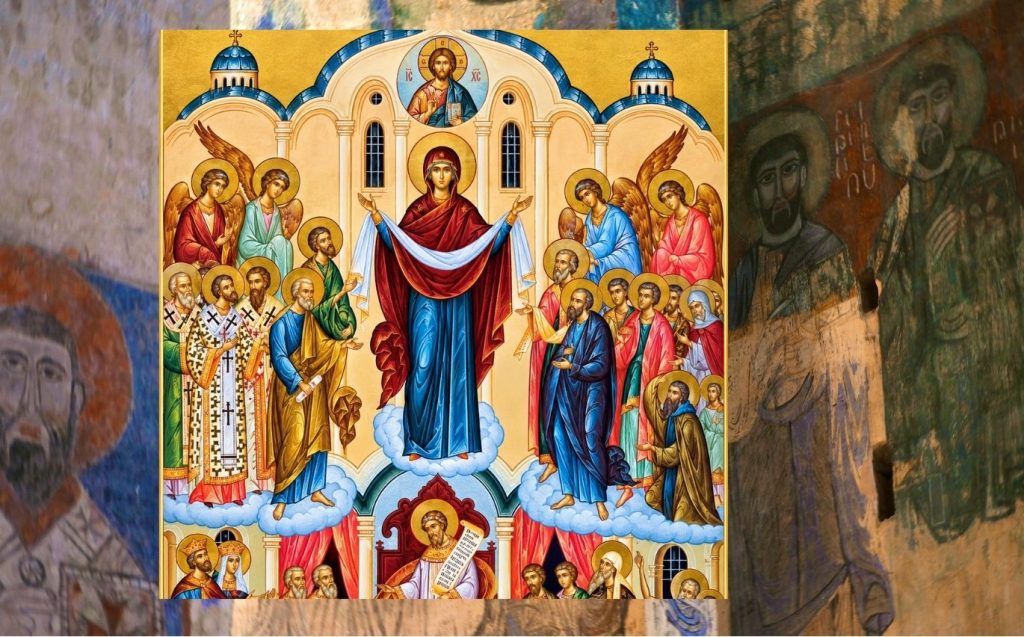
Покров Пресвятої Богородиці
Св. ап. Ананії, одного із сімдесятьох
Прп. Романа Сладкопівця
The Protection of our Most Holy Lady the Mother of God and Ever-Virgin Mary
Apostle Ananias of the Seventy
Venerable Romanus the Melodist, “Sweet-Singer”
The Synaxarion (Lives of the Saints):
This miraculous appearance of the Mother of God occurred in the mid-tenth century in Constantinople, in the Blachernae church where her robe, veil, and part of her belt were preserved after being transferred from Palestine in the fifth century.
On Sunday, October 1, during the All Night Vigil, when the church was overflowing with those at prayer, the Fool-for-Christ Saint Andrew (October 2), at the fourth hour, lifted up his eyes towards the heavens and beheld our most Holy Lady Theotokos coming through the air, resplendent with heavenly light and surrounded by an assembly of the Saints. Saint John the Baptist and the holy Apostle John the Theologian accompanied the Queen of Heaven. On bended knees the Most Holy Virgin tearfully prayed for Christians for a long time. Then, coming near the Bishop’s Throne, she continued her prayer.
After completing her prayer she took her veil and spread it over the people praying in church, protecting them from enemies both visible and invisible. The Most Holy Lady Theotokos was resplendent with heavenly glory, and the protecting veil in her hands gleamed “more than the rays of the sun.” Saint Andrew gazed trembling at the miraculous vision and he asked his disciple, the blessed Epiphanius standing beside him, “Do you see, brother, the Holy Theotokos, praying for all the world?” Epiphanius answered, “I do see, holy Father, and I am in awe.”
The Ever-Blessed Mother of God implored the Lord Jesus Christ to accept the prayers of all the people calling on His Most Holy Name, and to respond speedily to her intercession, “O Heavenly King, accept all those who pray to You and call on my name for help. Do not let them go away from my icon unheard.”
Saints Andrew and Epiphanius were worthy to see the Mother of God at prayer, and “for a long time observed the Protecting Veil spread over the people and shining with flashes of glory. As long as the Most Holy Theotokos was there, the Protecting Veil was also visible, but with her departure it also became invisible. After taking it with her, she left behind the grace of her visitation.”
Venerable Romanus the Melodist, “Sweet-Singer”
Saint Romanus the Melodist was born in the fifth century in the Syrian city of Emesa of Jewish parents. After moving to Constantinople, he became a church sacristan in the temple of Hagia Sophia. The monk spent his nights alone at prayer in a field or in the Blachernae church beyond the city.
The Synaxarion (Lives of the Saints):
Saint Romanus was not a talented reader or singer. Once, on the eve of the Nativity of Christ, he read the kathisma verses. He read so poorly that another reader had to take his place. The clergy ridiculed Romanus, which devastated him.
On the day of the Nativity, the Mother of God appeared to the grief-stricken youth in a vision while he was praying before her Kyriotissa icon. She gave him a scroll and commanded him to eat it. Thus was he given the gift of understanding, composition, and hymnography.
That evening at the all-night Vigil Saint Romanus sang, in a wondrous voice, his first Kontakion: “Today the Virgin gives birth to the Transcendent One…” All the hymns of Saint Romanus became known as kontakia, in reference to the Virgin’s scroll. Saint Romanus was also the first to write in the form of the Oikos, which he incorporated into the all-night Vigil at his places of residence (In Greek, “oikos”).
For his zealous service Saint Romanus was ordained as a deacon and became a teacher of song. Until his death, which occurred about the year 556, the hierodeacon Romanus the Melodist composed nearly a thousand hymns, many of which are still used by Christians to glorify the Lord. About eighty survive.