09/14/206 – Життя Святих / Lives of the Saints
Всесвітнє Воздвиження чесного й животворчого Хреста
The Universal Exaltation of the Precious and Life-Giving Cross
The Synaxarion (Lives of the Saints):
The pagan Roman Emperors tried to destroy the holy places where our Lord Jesus Christ suffered, died, and rose from the dead. Emperor Hadrian ordered Golgotha and the Lord’s Sepulchre to be buried, and a pagan temple dedicated to Venus and a statue of Jupiter were placed there.
After about 300 years, by Divine Providence, these holy places and the Life-giving Cross were discovered under Emperor Constantine the Great. After his victory over his enemies, Constantine became the sole ruler of the Roman Empire. In 313, he issued the Edict of Milan, which legalized Christianity and ended the persecution of Christians in the Western Empire.
Desiring to find the Cross of Christ, Constantine sent his mother, the pious Empress Helen, to Jerusalem. She visited the holy places connected with the earthly life of Christ and helped build many churches.
For a long time, her search for the Cross was unsuccessful. Finally, an elderly Jew named Jude revealed that the Cross was buried beneath the temple of Venus. The pagan temple was demolished, and the excavation uncovered the Lord’s Tomb, three crosses, the inscription placed by Pilate, and four nails.
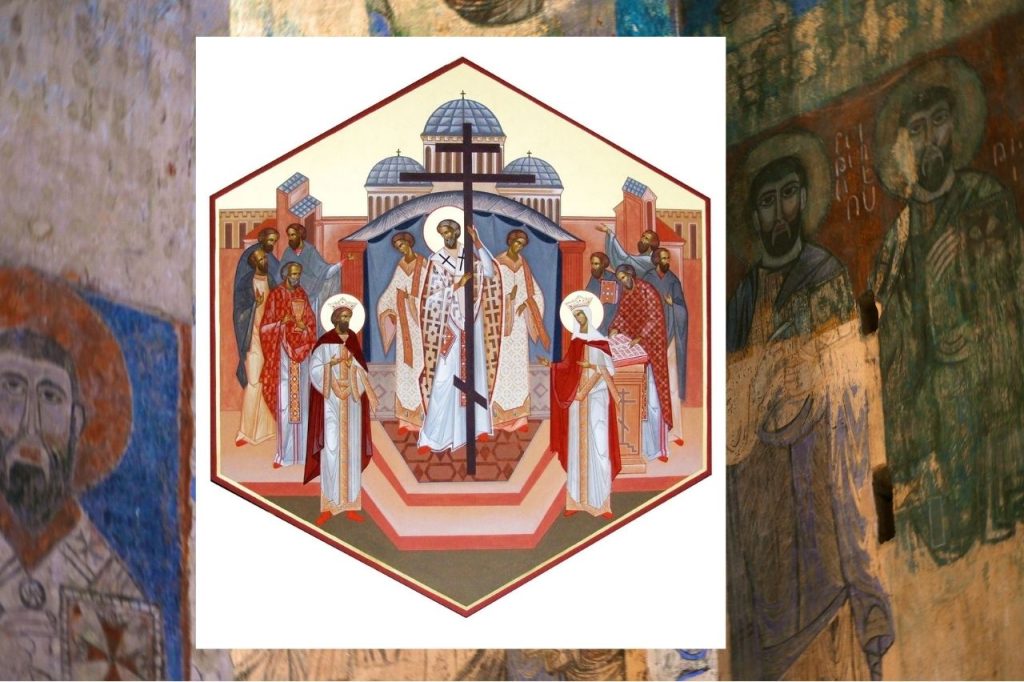
To discover which cross was the Cross of Christ, Patriarch Makarios touched each cross to the body of a dead man. When the Cross of the Lord touched him, he was restored to life. Everyone was convinced that the Life-giving Cross had been found.
Crowds of Christians came to venerate the Holy Cross. Patriarch Makarios lifted it high so that everyone could see it, and the people bowed before it, saying, “Lord, have mercy.” This took place in the year 326.
Saint Constantine ordered a great church to be built in Jerusalem over the Lord’s Tomb and Golgotha. It was consecrated on September 13, 335, and on the following day, September 14, the feast of the Exaltation of the Honorable and Life-giving Cross was established.
The Church also remembers the return of the Cross to Jerusalem after fourteen years in Persia. Emperor Herakleios brought it back in great solemnity. At the gates of Golgotha, however, he was unable to move forward. Patriarch Zachariah explained that the Emperor should remove his royal garments and walk barefoot, because Christ carried the Cross in humility. Herakleios did so and was then able to carry the Cross into the church.
The Cross reminds us that Christ saved the world through humility, suffering, and love. As Saint Andrew of Crete says: “The Cross is exalted, and everything true is gathered together.”