11/17/2026 – Життя Святих / Lives of the Saints
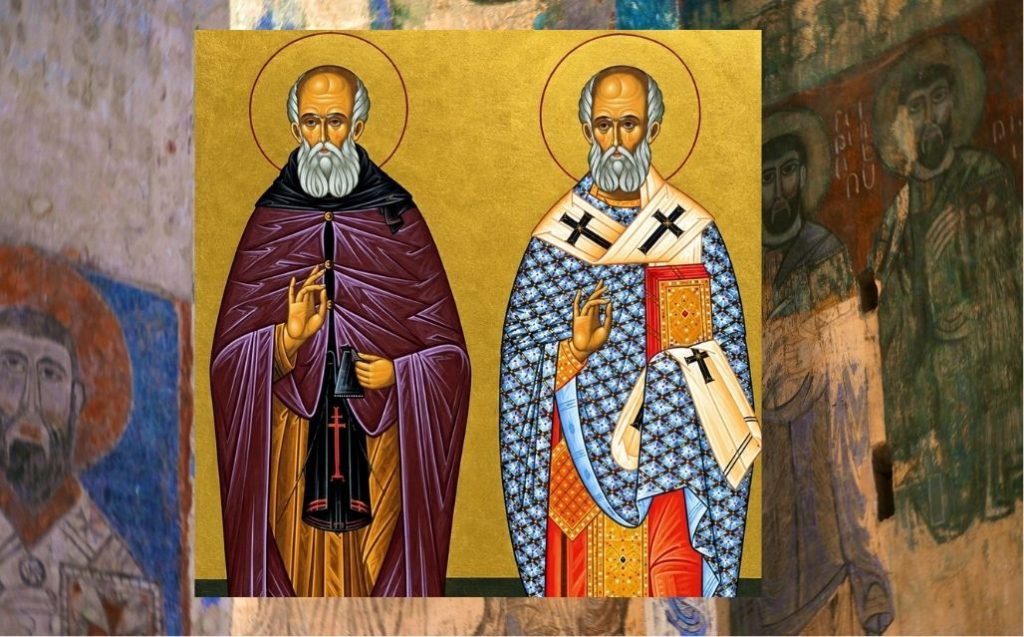
Св. Григорія, єп. Неокесарійського, чудотв.
Блаж. сщмч. Йосафата Коциловського
Saint Gregory, Wonderworker of Neocaesarea
Bl. Josaphat Kocylovskyj
The Synaxarion (Lives of the Saints):
Saint Gregory the Wonderworker, Bishop of Neocaesarea
Saint Gregory the Wonderworker was born in Neocaesarea, in northern Asia Minor, between 210 and 215, into a prominent pagan family. His original name was Theodore. After completing his early education, he went with his brother to Beirut to study law. However, his search for truth led him beyond the wisdom of ancient philosophers, and through the Gospel he discovered Christianity.
Gregory later traveled to Alexandria, where he studied at the Catechetical School under the renowned teacher Origen. He remained his pupil for eight years and was baptized by him. Gregory greatly admired Origen’s ability to explain the Word of God and regarded him as a spiritual guide.
His disciplined life, purity, and generosity stirred jealousy among his pagan companions. Once, while Gregory was speaking with philosophers in the city square, a woman publicly accused him of having committed a sin with her and demanded payment. Gregory calmly asked a friend to give her the money. As soon as she received it, she fell to the ground in a demonic fit. Gregory prayed over her, and the demon left her. This became the first of many miracles attributed to him.
After returning to Neocaesarea, Gregory withdrew into the wilderness, devoting himself to prayer and fasting. Although he wished to remain in solitude, God had other plans. Bishop Phaidemos of Amaseia chose him to become Bishop of Neocaesarea. Gregory initially hid from those sent to find him, but the bishop consecrated him in his absence. Recognizing this as God’s will, Gregory accepted his calling.
At that time, false teachings about the Holy Trinity were spreading through the Church. Gregory prayed earnestly for guidance. According to Church tradition, the Mother of God appeared to him with the Apostle John the Theologian, who revealed the true teaching concerning the Holy Trinity. Gregory wrote down this teaching in the Symbol of Faith, which became an important witness to the Church’s understanding of the Trinity and was later affirmed at the First Ecumenical Council in 325.
On his way to Neocaesarea, Gregory cast demons out of a pagan temple and converted its priest to Christianity. God also worked many wonders through him. Gregory healed the sick, helped the poor, settled disputes, and preached with great wisdom. When two brothers nearly came to violence over ownership of a lake, Gregory prayed throughout the night. By morning, the lake had disappeared, leaving a stream that clearly marked the boundary between their lands. On another occasion, he commanded a hill to move so that a church could be built.
During the persecution under Emperor Decius (249–251), Gregory led his people to a mountain to escape the soldiers. When the persecutors surrounded the area, he and his deacon stood in prayer. Although the soldiers searched the mountain, they could not see them and eventually left. The pagan who had revealed the Christians’ hiding place was so astonished by this event that he repented and became a Christian.
After the persecution ended, Gregory returned to Neocaesarea and established commemorations honoring the martyrs who had suffered for Christ. Through his holiness, preaching, miracles, and pastoral care, he brought many people to the Christian faith.
When Saint Gregory first became bishop, only seventeen Christians lived in Neocaesarea. By the end of his life, only seventeen pagans remained in the city. His ministry transformed the spiritual life of the entire region and earned him the title of Wonderworker.
+++ +++
Bl. Josaphat Kocylovskyj
Josaphat Joseph Kotsylovsky (1876–1947) was a Ukrainian Greek Catholic bishop and martyr born in Pakoszowka, then part of Austria-Hungary (now Poland). Of Lemko origin and with a strong Ukrainian national orientation, he studied law at Lviv University but pursued a military career after artillery training in Vienna.
Upon leaving the military, Kotsylovsky, with support from Bishop Kostyantyn Chekhovych, undertook theological studies in Rome, graduating in 1907. Ordained a priest on October 9, 1907, he later became vice-rector and theology professor at the Greek-Catholic seminary in Stanislaviv. Joining the Order of Saint Basil the Great in 1911, he was ordained a bishop by Andrey Sheptytsky in 1917.
As bishop, Kotsylovsky focused on improving the church’s educational system, supporting monastic orders, and countering the Russophile movement by promoting Ukrainian priests and language.
In 1941, he welcomed Wehrmacht forces in Przemyśl, and in 1943, he led a Mass for volunteers entering the 14th SS Division.
Following World War II, as Communist Poland collaborated with the Soviet Union to suppress the Ukrainian Greek Catholic Church, Kotsylovsky faced persecution. Arrested by Polish and Soviet security services, he died on November 17, 1947, in a prison camp near Kyiv.
Pope John Paul II beatified Kotsylovsky on June 27, 2001. The relics of this martyr are preserved in the church of the Annunciation of the Blessed Virgin Mary in Stryi.
Blessed Josaphat, pray for us!