11/11/2026 – Життя Святих / Lives of the Saints
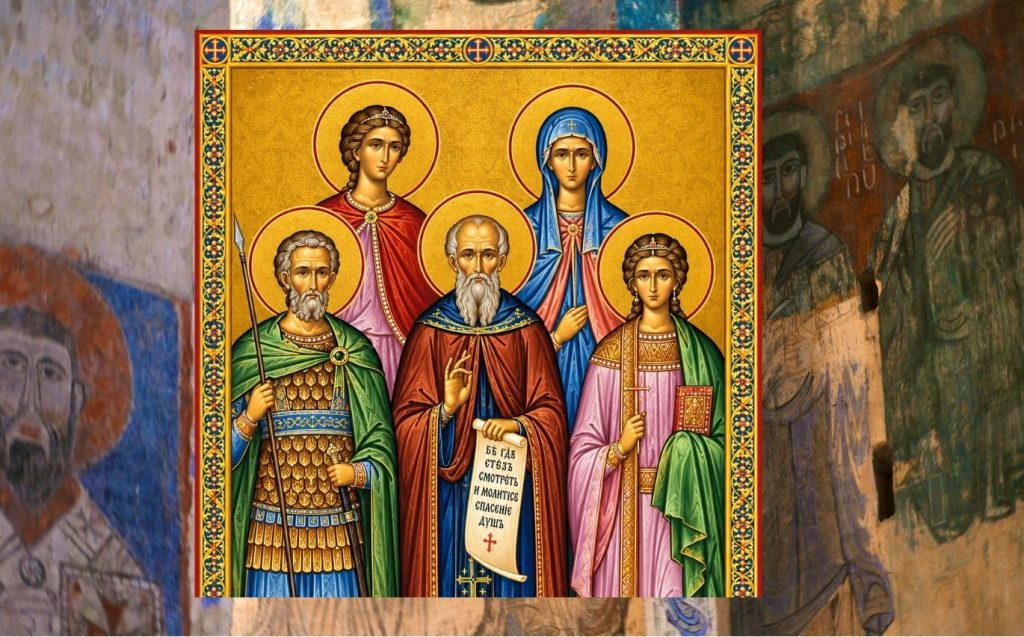
Свв. мчч. Мини, Віктора й Вінкентія
Св. мц. Стефаніди
Прп. й ісп. Теодора Студійського
Martyr Menas of Egypt
Martyr Victor at Damascus
Martyr Vincent of Spain
Martyr Stephanida of Damascus
Venerable Theodore the Confessor, Abbot of the Studion
The Synaxarion (Lives of the Saints):
Holy Great Martyr Menas
Saint Menas was an Egyptian by birth and served as a military officer in Phrygia during the reigns of Emperors Diocletian and Maximian. He was respected for his courage, patience, and discipline.
In 298, when the emperors ordered the persecution of Christians, Saint Menas refused to obey their commands. He cast aside his military belt and withdrew to the mountains, where he devoted himself to fasting, prayer, and night vigils. After many years of ascetic struggle, he received a vision that he understood as a call to martyrdom.
Saint Menas then entered the city during a pagan festival and boldly proclaimed that Jesus Christ was the only true God. He denounced the idols as lifeless objects made by human hands. The crowd seized him and brought him before the prefect Pyrrhus.
Although offered the restoration of his military rank in exchange for sacrificing to the pagan gods, Saint Menas remained steadfast in his faith. He endured severe tortures but refused to deny Christ. Finally, he was sentenced to beheading. Before his execution, he asked his Christian friends to take his body to Egypt after the persecution ended. His relics were eventually placed in a church dedicated to him near Alexandria.
Saint Menas received the crown of martyrdom in 304. Through God’s grace, he is honored as a wonderworker who helps those suffering from illnesses and spiritual afflictions. He is also invoked for protection in times of war and for help in finding lost objects.
Holy Martyr Victor of Damascus
Saint Victor was a Christian soldier who lived during the reign of Emperor Marcus Aurelius (161–180). When persecution began, he refused to sacrifice to the pagan gods and was subjected to cruel tortures. Yet, through God’s power, he endured them unharmed.
Through Saint Victor’s prayers, a sorcerer abandoned his former practices and became a Christian. The saint also prayed for blind soldiers, who miraculously regained their sight.
Stephanida, a fifteen-year-old Christian woman and the wife of one of Victor’s torturers, witnessed these miracles and openly confessed her faith in Christ. For this, she was condemned to a terrible death: she was tied to two palm trees bent toward the ground, which sprang back and tore her body apart.
Saint Victor was eventually sentenced to beheading. Before his execution, he foretold that his executioners would die within twelve days and that their commander would be captured by the enemy within twenty-four days. His predictions came to pass.
Saint Victor and Saint Stephanida suffered martyrdom in Damascus in the second century. Their memory bears witness to the power of faith and the courage to confess Christ even in the face of death.
Holy Martyr Vincent of Spain
Saint Vincent was born in Spain and from childhood became a disciple of Bishop Valerian of Augustopolis, identified in the account with present-day Zaragoza. He received a thorough education and became known for his wisdom, eloquence, and virtue. Because Bishop Valerian had difficulty speaking publicly, he entrusted Vincent with preaching the Gospel.
During the persecution under Emperor Diocletian, the governor Dacian was sent to Spain to arrest Christians. Both Bishop Valerian and Deacon Vincent were seized and taken in chains to Valencia, where they were imprisoned and tortured.
During his interrogation, Bishop Valerian spoke with difficulty, but Saint Vincent boldly proclaimed the Christian faith before the governor and the assembled people. Enraged by his fearless confession, the persecutors subjected him to terrible torments. He was nailed to a cross, beaten, and burned with red-hot rods. Even after being removed from the cross, he courageously climbed back onto it, challenging his executioners to complete their task.
Exhausted by their cruelty, the torturers finally cast him into prison. During the night, the guards heard him singing psalms and witnessed a radiant, heavenly light filling his cell.
The following morning, Saint Vincent was condemned to be burned on a gridiron. Christians later recovered his body and buried it with reverence. He received the crown of martyrdom in 304, remaining faithful to Christ through every suffering.
Holy Martyr Stephanida
Saint Stephanida was a young Christian woman who witnessed the martyrdom of Saint Victor in Damascus during the reign of Emperor Marcus Aurelius.
Seeing how Saint Victor endured torture through the power of God, she was moved to proclaim her faith in Jesus Christ openly. Her courageous confession led to her own condemnation.
Although only fifteen years old, Stephanida faced death with remarkable steadfastness. She was tied to two palm trees bent toward the ground. When the trees were released, they sprang back and tore her body apart.
Saint Stephanida suffered martyrdom in Damascus in the second century. Her witness reminds the faithful that even the youngest can show extraordinary courage and unwavering devotion to Christ.
Saint Theodore the Confessor, Abbot of the Studion Monastery
Saint Theodore the Studite was born in Constantinople in 758 to Photinus, an imperial tax official, and his pious wife, Theoctiste. He received an excellent education in rhetoric, philosophy, and theology and became well known for his knowledge of Scripture and his defense of the Orthodox faith.
During his youth, the Byzantine Empire was troubled by the heresy of Iconoclasm, which rejected the veneration of holy icons. Theodore’s family remained faithful to Orthodoxy. His parents eventually gave their possessions to the poor and embraced monastic life.
Theodore became a gifted defender of the Church’s teaching, engaging in debates with those who opposed the holy icons. The Seventh Ecumenical Council, held under Empress Irene, condemned Iconoclasm and restored peace to the Church.
Encouraged by his uncle, Saint Platon, Theodore and his brothers entered monastic life at Sakkoudion near Mount Olympus. There they established a monastery dedicated to Saint John the Theologian. Theodore embraced a strict ascetic life, devoting himself to prayer, fasting, manual labor, Scripture, and the writings of the Holy Fathers, especially Saint Basil the Great.
After being ordained a priest, Theodore was chosen as abbot following the repose of Saint Platon. He guided the monks through his own example of discipline and holiness as well as through his spiritual teaching.
Saint Theodore fearlessly defended the Church’s canons, even when this brought him into conflict with the emperor. Because he publicly condemned the unlawful actions of Emperor Constantine VI, he and several monks were exiled to Thessalonica. After Empress Irene returned to power, Theodore was released and appointed abbot of the Studion Monastery in Constantinople.
Under his leadership, the monastery flourished, eventually gathering approximately one thousand monks. Theodore established a monastic rule that became known as the Studite Rule and wrote numerous works defending Orthodox teaching and the veneration of icons. His spiritual writings and firm witness earned him recognition as a great teacher of the Church.
When Iconoclasm returned under Emperor Leo V the Armenian, Saint Theodore once again raised his voice in defense of the holy icons. He and his disciple Nicholas were imprisoned, tortured, and sent into exile. Despite hunger, illness, and severe suffering, Theodore continued to encourage the faithful to remain steadfast in Orthodoxy.
After Leo’s death, Emperor Michael II released the imprisoned confessors but continued to restrict the veneration of icons in Constantinople. Saint Theodore chose to settle in Bithynia, where he continued to celebrate the Divine Liturgy and guide his monastic community despite his failing health.
Foreseeing his approaching death, he urged the monks to preserve the Orthodox faith, venerate the holy icons, and remain faithful to their monastic rule. As the brethren sang prayers for the departing soul, Saint Theodore reposed in the Lord in 826.
Saint Theodore was renowned for miracles both during his life and after his death. Through his intercessions, many have received healing and protection from danger. The Church commemorates the transfer of his relics to Constantinople in 845 on January 26. Those suffering from stomach ailments traditionally seek his prayers.